Devon & Severn IFCA has published a new Code of Conduct for fishing with pots and traps in Torbay Marine Conservation Zone (MCZ).
The Code has been co-developed with local commercial potting permit holders and aims to reduce impacts on sensitive seagrass habitats while supporting the continuation of local fishing activities.
This approach reflects ongoing collaboration between IFCA Officers and the fishing community, and we would like to thank all those who contributed their time and experience during the development of the Code.
Why a Code of Conduct?
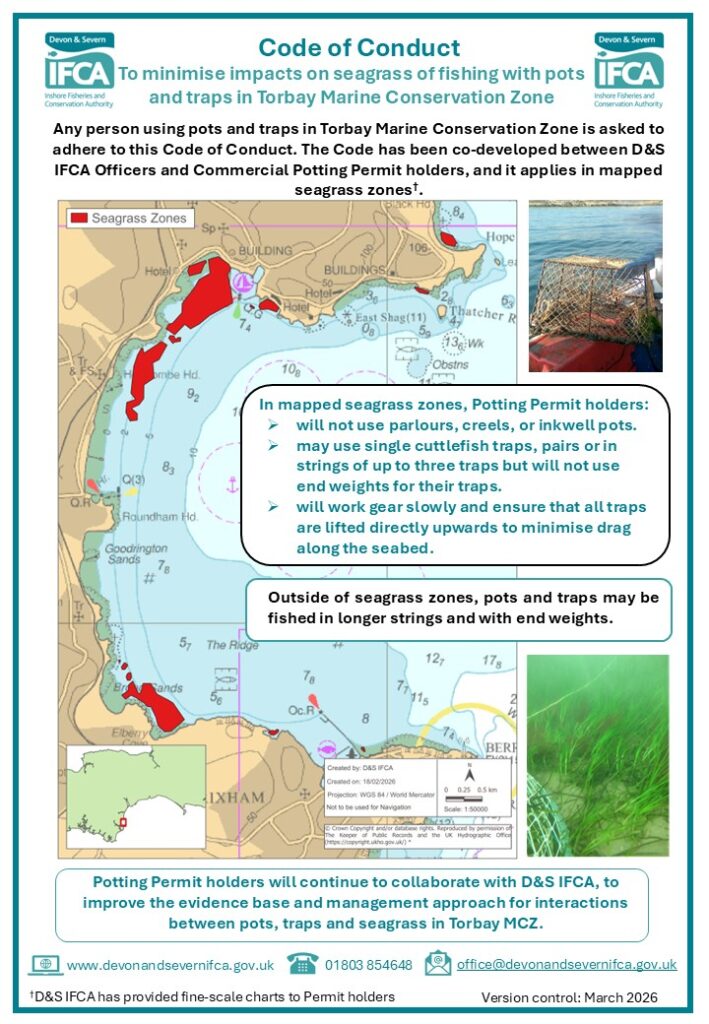
Torbay MCZ contains several protected seagrass beds, which are important marine habitats and require careful management.
The Code of Conduct is a proportionate and flexible management tool that is a practical way for local fishers and D&S IFCA to work together to minimise impacts to seagrass without the need for formal regulation.
Officers will continue to monitor activity in the MCZ and report findings to IFCA Members. If there is strong adherence to the Code and minimal evidence of seagrass damage, this voluntary approach is likely to remain appropriate.
What Does the Code Require?
The Code sets out simple, practical measures that apply only within mapped seagrass zones. Key points include:
- No use of parlours, creels, or inkwell pots within seagrass zones.
- Cuttlefish traps may be used singly, in pairs, or in strings of up to three traps, but no end weights are permitted in seagrass zones.
- All traps should be hauled slowly and vertically to minimise drag along the seabed.
- Outside the seagrass zones, pots and traps may continue to be fished as usual.
The Code includes detailed maps and coordinate tables for all seagrass zones across Torbay. Waterproof hard‑copy maps are available from D&S IFCA on request.
Working Together on Research
A key part of the Code is a shared commitment to improving the evidence base on how potting interacts with seagrass. Officers will be carrying out collaborative research with Permit holders during the spring 2026 cuttlefish season, and participating fishers will be financially compensated for their time.
The results of this work will be shared later in the year, followed by a meeting to discuss next steps. If new evidence shows that impacts are lower than previously thought, there may be opportunities to adjust or expand access in some areas.
Other Activities Affecting Seagrass
D&S IFCA recognises that fishing is not the only source of pressure on seagrass habitats. Concerns about anchoring by recreational vessels and other non‑fishing activities continue to be raised with the Marine Management Organisation and Tor Bay Harbour Authority.
Get Involved or Ask Questions
IFCA Officers have contactedall Potting Permit holders who fish in Torbay to explain the Code and are now inviting participation in research work. We encourage fishers to take part, and we appreciate the continued collaborative approach.
If you would like to discuss the Code, request waterproof maps, or talk about taking part in the research, please get in touch using the contact details on the first page of the Code of Conduct, which is available here.
To find out more about the responsibilities of D&S IFCA and the work it undertakes, please visit the About Us page on our website. The website also hosts a range of information including Enforcement and Legislation and Marine Protected Areas in D&S IFCA’s District.