Enforcement and Legislation
Page review/updated 15/10/2026
(Content of page updated: October 2026)
This page and the folders below enable you to view some important information such as the Permit Byelaws, Permit Conditions, and the whole Byelaw Book. Information about different legislation can also be found in Section E of the Resource Library.
ENFORCEMENT OVERVIEW
The Enforcement team consists of five Inshore Fisheries and Conservation Officers (IFCOs). The contact details for the Enforcement Officers are set out on our Contact Us page. The Enforcement team’s knowledge and expertise is extensive and underpinned by a varied background of Enforcement work. Priority workstreams for the Enforcement Team each year are set out in D&S IFCA’s Annual Plans.
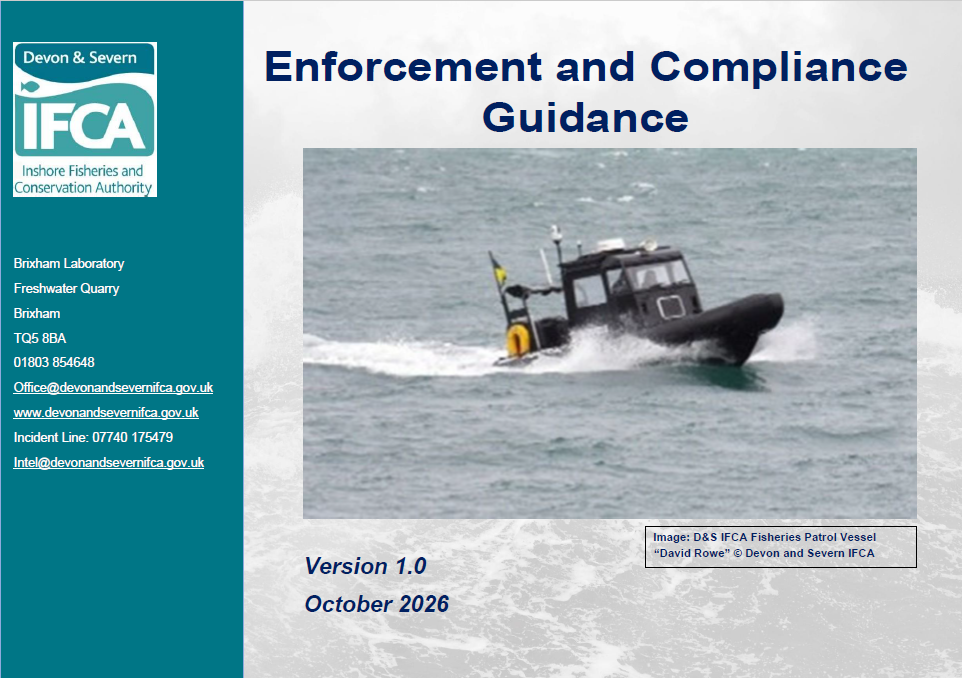
In October 2026, D&S IFCA produced its own Enforcement and Compliance Guidance that sets out how D&S IFCA approaches its enforcement work and details the following (and more).
- Compliance Aims
- Enforcement Priorities
- Enforcement Operations
- Use of Technology
- Working Together
- Investigation Process and Disposal Options
The Guidance can be read here.
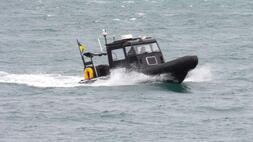
Sea patrols are governed by intelligence received and inputted into the national intelligence model which is shared amongst other Agencies. The Enforcement team currently have use of one D&S IFCA owned Rigid Inflatable Boat (R.I.B). The vessel is 7.8 metres long and named the David Rowe to honour the memory of a former Authority Member. This vessel can be transported via trailer throughout the extent of the District.
D&S IFCA makes use of technology to support the delivery of its enforcement work including IVMS (introduced as a mobile fishing permit condition) and has undertaken trials of on board Remote Electronic Monitoring (REM) technologies. In addition, D&S IFCA Enforcement Officers use drones for enforcement and monitoring purposes.
The IFCOs’ work comprises of varied shift patterns; incorporating reactive working to respond to immediate threats to the local fishery.
Joint working with the Marine Management Organisation (MMO), the Environment Agency (EA), other IFCAs, and the Police is paramount as we move forward in sharing resources and this ensures that enforcement work isn’t duplicated.
Investigation Outputs
Information from patrols, investigations, boardings and prosecutions is recorded on the Monitoring Control Surveillance System (MCSS) which is shared with the MMO.
- The outcomes from D&S IFCAs investigations are published on our Investigation Outcomes website page.
Legislation and Reporting Suspicious Activity
If you have a general enquiry about our legislation, please contact us.
If you suspect any suspicious or illegal fishing activity, you have options how to report this. We have a dedicated Reporting Illegal Fishing Activity website page that includes a reporting form. This form enables you to report without providing your name or contact details.
We also have an Incident Line – 07740 175479
You can also email:
intel@devonandsevernifca.gov.uk
If you have a general enquiry about our legislation, please Contact Us. If you suspect any suspicious or illegal fishing activity, you have options how to report this.
We have a dedicated “Reporting Illegal Fishing Activity” website page that includes a reporting form. This form enables you to report without providing your name of contact details.
We also have an or have an Incident Line – 07740175479
You can also email:
intel@devonandsevernifca.gov.uk
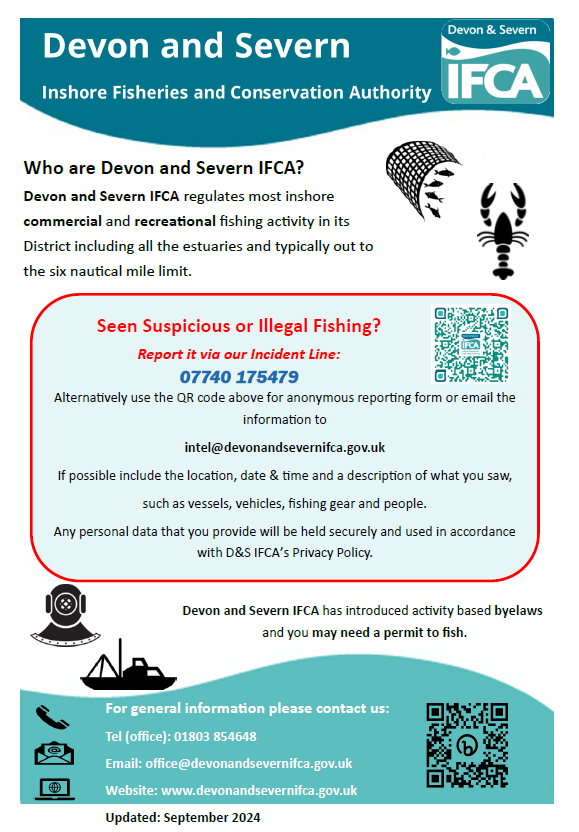
Officers have produced a flyer (image right) that also gives details about D&S IFCA and reporting suspicious or illegal fishing activity. The flyer can be downloaded by clicking here.
Any personal data that you provide will be held securely and used in accordance with D&S IFCA’s Privacy Policy and Data Protection Register.
Permits are needed to conduct Mobile Fishing, potting, netting and diving for scallop, crab and lobster. Permits are needed to conduct these activities commercially and recreationally.
The folders in this section are divided into different fishing methods (Mobile Fishing, Potting, Netting and Diving)
The contents of each folder includes the individual Permit Byelaws, the Permit Conditions, the Annexes (that accompany the Permit Conditions), Policy and Guidance information and also the Application Forms for you to acquire your chosen Permit.
A temporary closure of public mussel beds in both the Teign and Exe Estuary has been implemented. Defined areas in both estuaries have been closed from 1st May 2019.
The closure applies to both commercial and recreational fishers and is for mussel and not other shellfish species
The table provides an insight into the status of various D&S IFCA investigations.
The D&S IFCA Byelaw Book lists all the Byelaws, including those inherited from Devon Sea Fisheries which remain in force.
The folder also provides a list of Minimum Conservation Reference Sizes (MCRS) for fish and shellfish species.