D&S IFCA has published a stakeholder engagement report on the whelk fishery.
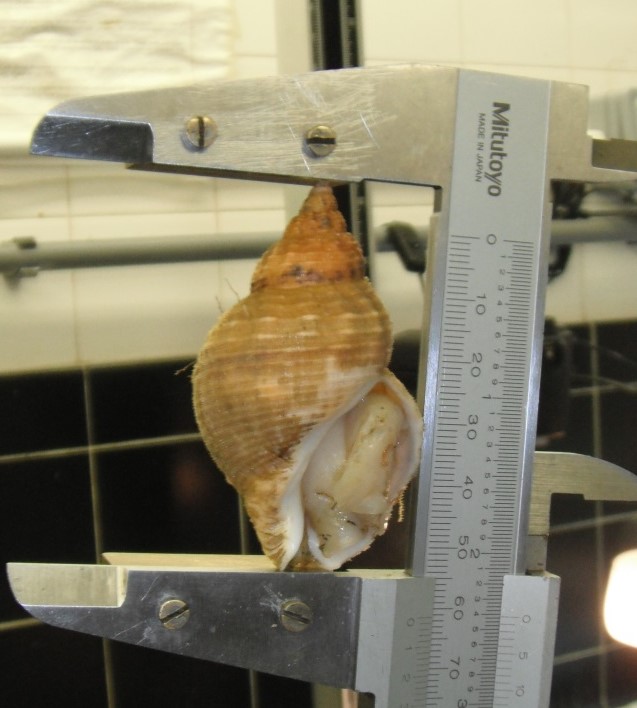
Survey work conducted between 2013 and 2016 to investigate the Size of Maturity (SOM) of whelk spawning in the D&S IFCA District demonstrated that the EU Minimum Conservation Reference Size (MCRS) of 45mm was insufficient to protect the spawning stocks and the sustainability of the population. As a result, D&S IFCA revised its management measures in November 2018 through its Potting Permit Byelaw Conditions, increasing the MCRS of whelks within the District to 65mm over a two-year period (increased to 55mm in November 2018 and 65mm in November 2020).
Evaluating Change in Management
For the 2025/2026 Annual Plan, D&S IFCA identified the need to evaluate outcomes of the change in management measures and to gain an insight into industry perspectives of any change in the whelk fishery over this time. It was determined that stakeholder engagement in the form of telephone interviews should be undertaken to assess any impacts of the increase in MCRS on both industry and whelk stocks within the District.
- The Summary of Response Report can be read here.
What did the stakeholder engagement involve?
The interviews consisted of a questionnaire containing 15 questions and focused on the following themes: perceived impact of MCRS management measures; bait use; economic viability and market access; fishing effort; gear types; spatial distribution; potential future management and the national Whelk Fisheries Management Plan (FMP).
Who was involved in the engagement?
Fisheries landings data from 2019–2023 were reviewed to understand levels of whelk fishing activity among D&S IFCA Potting Permit holders, including how important whelk fishing was to each vessel compared to other species. Permit holders were then contacted in a structured way to ensure that those most engaged in the whelk fishery, across both the north and south of the District, were included. For the north of the District, a total of 11 vessels were identified, and 26 vessels were identified for the south of the District. A total of 19 fishers provided responses during the telephone interviews.
Summary of the interviews and findings
The core season for whelk fishing appears to be from November to June with the majority of fishers fishing both within and outside the D&S IFCA’s District, although this seems to be more prevalent in the north of the District. The frequency of fishing varies between the north and south of the District. In the north, four days a week appears to be the average whereas in the south it is seven days a week (weather depending). There are a variety of different pots used, with the most common being FishTek, Micky Whelk and Mustang. There is a total of 10,815 pots reported between the 19 individuals who participated in the consultation.
Many fishers thought that the increase in the MCRS appears to have resulted in a decrease in whelk landings in both the northern and southern areas of the District. Some fishers suggested that the inshore whelk population does not typically attain the MCRS of 65mm, and fishers believe that this is responsible for a decrease in landings.
The increase in MCRS was made in order to improve the sustainability of the stock. An initial decrease in landings can be anticipated as a consequence of the increase in MCRS, as a larger proportion of individuals are returned. This is an important part of the MCRS strategy, which aims to allow a larger proportion of the stock to breed at least once before being captured. As the lifespan of whelk can be five to seven years, the longer-term benefit of the MCRS change to the population and fishery may only just be emerging.
Individuals also stated that a decrease in landings was a reason for them moving their fishing activity to areas outside the District where the MCRS remains 45 mm. Furthermore, it is thought that whelk size appears to be influenced by habitat type and geographic location.
Although not everyone agreed with the implementation of the new management measures, it was deemed by most that the way it was implemented, via a phased approach (over two years), was a lot more manageable.
The most common type of bait used is brown crab (which acts as an attractant) and dogfish, (which keeps the whelk feeding whilst in the pot). This was also reflected in the national Crab and Lobster Fisheries Management Plan (FMP). In terms of management, the predominant suggestion was to reduce the MCRS back to either 50 or 55mm. This is based on the participants’ claim that the inshore population of whelk do not reach the current MCRS of 65mm. Pot limitations were also mentioned by five respondents as another form of management that could help support the future of the fishery (by three respondents in the south of the District, and two in the north).
The introduction of a whelk permit or entitlement as part of the whelk FMP was also discussed with participants. It was made clear that D&S IFCA had not supported this suggestion and was not yet aware of what the process would involve. The majority of participants were in favour of a whelk permit or entitlement. The primary rationale for supporting this was the potential to prevent vivier vessels and other larger vessels from entering the fishery. However, some concerns were raised about the whelk permit or entitlement restricting fishers from diversifying to this species if other fisheries were experiencing declines.
Next Steps
Key themes emerging from responses include: spatial variation in catch composition (particularly size); operational adjustments; reduction in landings and potential economic implications for vessels. Potential next steps include; review of evidence, further data collection or research and ongoing stakeholder engagement. These will be valuable for validating any effects and understanding the stock-level impacts of the MCRS change, which was expected to improve the size of the breeding stock over time. The information gathered in the report could be used alongside other scientific evidence, landings data, and other monitoring information to support future assessment and help inform any subsequent management decisions regarding the whelk fishery.
To find out more about D&S IFCA’s whelk research work, including the reports from Size of Maturity Reports from 2015 and 2016 please visit the Whelks display page on our website.