Code of Conduct Torbay MCZ
Website page created/updated: 13th April 2026.
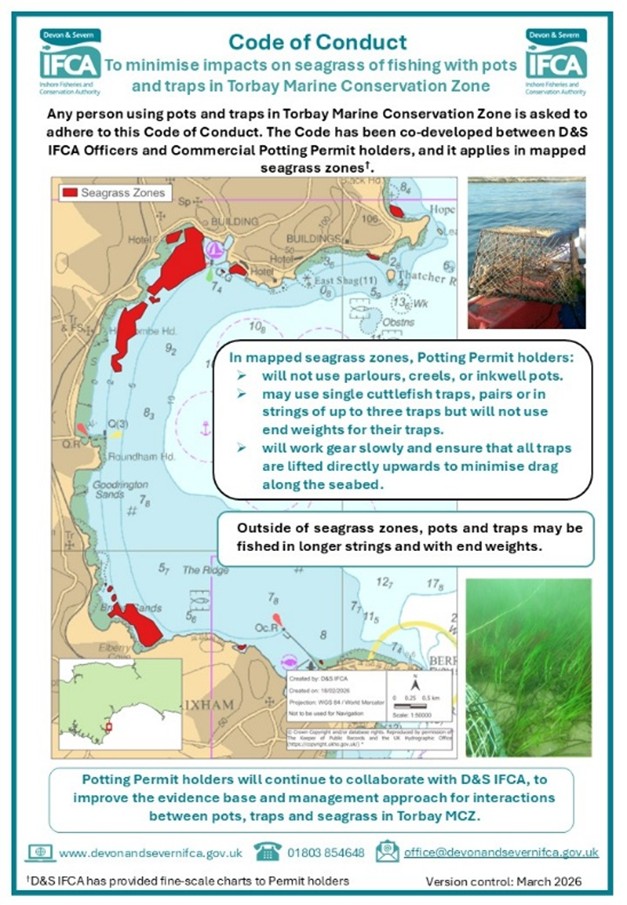
Devon & Severn IFCA has published a new Code of Conduct for fishing with pots and traps in Torbay Marine Conservation Zone (MCZ).
The Code has been co-developed with local commercial potting permit holders and aims to reduce impacts on sensitive seagrass habitats while supporting the continuation of local fishing activities.
This approach reflects ongoing collaboration between IFCA Officers and the fishing community, and the knowledge and expertise of fishers has been essential in the co-development of the Code.
Why a Code of Conduct?
Torbay MCZ contains a range of designated habitats and species, including seagrass Zostera marina and the long snouted seahorse, Hippocampus guttulatus. There are several protected seagrass beds close inshore around Torbay, and as important marine habitats they require careful management.
The Code of Conduct, which can be viewed here, is a proportionate and flexible management tool that is a practical way for local fishers and D&S IFCA to work together to minimise impacts to seagrass without the need for formal regulation. D&S IFCA has also produced a final report which provides an overview of how a Code of Conduct for fishing with pots and traps within mapped seagrass zones in the Torbay Marine Conservation Zone (MCZ) has been co-developed.
Officers will monitor activity in the MCZ and report findings to D&S IFCA Members. If there is strong adherence to the Code and minimal evidence of seagrass damage, this voluntary approach is likely to remain appropriate.
What Does the Code Require?
The Code sets out simple, practical measures that apply only within mapped seagrass zones. Key points include:
- No use of parlours, creels, or inkwell pots within seagrass zones.
- Cuttlefish traps may be used singly, in pairs, or in strings of up to three traps, but no end weights are permitted in seagrass zones.
- All traps should be hauled slowly and vertically to minimise drag along the seabed.
- Outside the seagrass zones, pots and traps may continue to be fished as usual.
The Code includes detailed maps and coordinate tables for all seagrass zones across Torbay.
Working Together on Research
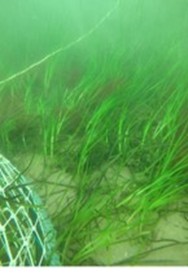
A key part of the Code is a shared commitment to improving the evidence base on how potting interacts with seagrass. Officers will be carrying out collaborative research with Permit Holders during the Spring 2026 cuttlefish season, and participating fishers will be financially compensated for their time. This research work will be supported by Defra funding.
The research will further assess impacts of pots and traps on seagrass and will include attaching GoPro cameras to cuttlefish traps and pots to observe them underwater and to film the hauling process to assess the impact of hauling different number of pots per string on the seagrass. There may be potential to use a remotely operated underwater vehicle to film the gear and end weights on the seabed.
D&S IFCA will engage regularly with fishers to improve collective knowledge and understanding of the cuttlefish fishery. The results of this work will be shared with fishers later in the year, followed by a meeting to review the evidence gathered and discuss next steps.
D&S IFCA’s Environment Team will undertake this work with support from the Enforcement Team. Monitoring will include use of IVMS, direct observation and intelligence reports submitted by stakeholders. The findings of the research and monitoring adherence to the Code of Conduct will be reported to D&S IFCA’s Byelaw and Permitting Sub-Committee (B&PSC) Members later in 2026. If new evidence shows that impacts are lower than previously thought, there may be opportunities to adjust or expand access in some areas.
Other Activities Affecting Seagrass
D&S IFCA recognises that fishing is not the only source of pressure on seagrass habitats. Concerns about anchoring by recreational vessels and other non‑fishing activities continue to be raised with the Marine Management Organisation and Tor Bay Harbour Authority.
Further Information
Further information relating to work undertaken by D&S IFCA in relation to the Torbay MCZ and the development of the Code of Conduct can be viewed via the links below:
- Marine Conservation Zone Assessment (TOR-MCZ-005-V4 – April 2025)
- NE Formal Advice May 2025 on D&S IFCA Torbay MCZ Assessment Static Pots vs Seagrass 2025 V4
- Monitoring and Control Plan – Torbay MCZ – Potting on Seagrass V1 (August 2023)
- B&PSC Paper Agenda Item 7 – October 2025 and Minutes of that meeting
- B&PSC Paper Agenda Item 10 – February 2026.
To find out more about the responsibilities of D&S IFCA and the work it undertakes, please visit the About Us page on our website. The website also hosts a range of information including Enforcement and Legislation and Marine Protected Areas in D&S IFCA’s District.