
D&S IFCA publishes its 2026 Exe Estuary mussel and cockle stock reports, detailing the findings of the biennial surveys, conducted in 2026.
Mussel Surveys
On 19th April and 1st May 2026 D&S IFCA Officers undertook a survey, as set out in D&S IFCA’s 2026-2027 Annual Plan, of the mussel beds in the Exe Estuary.
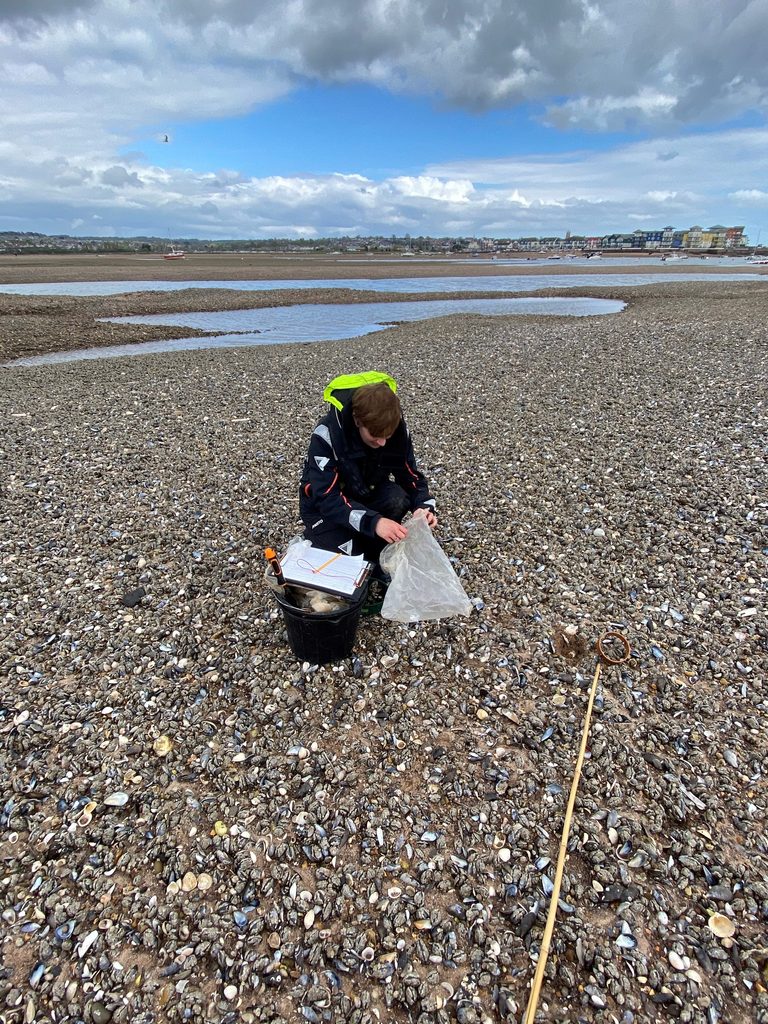
The mussel beds are important as a food source supporting a range of bird species. For example, several thousand oystercatchers overwinter on the Exe Estuary and predominantly feed on the mussels. Oystercatchers and other birds in the waterbird assemblage are protected features of the Exe Estuary Special Protection Area (SPA).
D&S IFCA introduced a temporary closure (relating only to mussel), from 1st May 2019 on the public shellfish beds in the Exe Estuary due to stocks of mussel in these areas being severely depleted. The chart defining the temporary closure was updated in July 2023 and can be viewed here.
What are the results from the survey?
- The 2026 Exe Estuary Mussel Stock Assessment Report can be read here.
The density and percentage cover of mussel remain low, and the total area covered by mussel is very small compared to the early 2010s, reflecting that the bed still has not recovered from the decline in 2013 – 2014.
Relatively few young mussels were found, suggesting that new mussels are not currently replacing those being lost, making recovery more difficult. Although a mussel settlement event was reported at Bull Hill Bank shortly before the survey, little or no young mussels were found during the survey. This suggests that the settlement was not sustained.
Next Steps
D&S IFCA has recommended that mussel surveys continue every two years to monitor the stock for signs of further decline or recovery. Survey methods are being refined to improve consistency in spatial coverage and precision in the calculations of mussel tonnage. Biennial surveys can also support development of a Molluscan Shellfish Hand Gathering Permit Byelaw.
Cockle Surveys
On 13th August 2026 D&S IFCA Officers undertook a stock assessment, as set out in D&S IFCA’s 2026-2027 Annual Plan, of the cockle beds on the Exe Estuary. Cockles are an important food source for wading birds on the Exe Estuary, so changes in their numbers and size may affect the food available to birds. However, the impact on overwintering birds cannot be determined from the cockle survey alone.
What are the results from the survey?
The 2010 – 2026 Exe Estuary Cockle Stock Assessment Report can be found here.
Overall, adult cockle density has continued to decline over the longer term from 2011 to 2026. Juvenile numbers have varied considerably between years, with smaller cockles continuing to be recorded in recent surveys. Cockle densities and sizes also varied across the survey area. Due to limited resources, the area surveyed was smaller than in previous years, though the amount of cockle within the surveyed area was comparable to that in 2024.
Next Steps
D&S IFCA will continue to carry out autumn cockle surveys on a biennial basis, using consistent methods wherever possible. This will help build a clearer picture of how the stock changes over time and support future assessment of cockles as an important prey resource for birds on the Exe Estuary.
These repeat surveys of the mussel and cockle beds can also inform future development of a Molluscan Shellfish Hand Gathering Permit Byelaw.
More Information
If you would like to find out more about D&S IFCA’s cockle and mussel and cockle survey work, please visit our website display pages:
Enforcement
D&S IFCA has a risk based and intelligence led approach to its enforcement work and actively encourages the reporting of suspected illegal fishing. Please note that the temporary closure on the public beds in the Exe Estuary is only for mussel and not for other species, such as cockle. D&S IFCA’s webpage on Reporting Illegal Fishing provides stakeholders with options of how they can report to us. These options include the Incident Line: 07740 175479, and an anonymous online reporting form.