Marine Protected Areas (Site Specific Work)
Page review/updated 09/10/2026
Page Updated: 9th October 2026
Marine Protected Areas (MPAs) are important designations to allow the protection of key habitats and species from damaging activities. D&S IFCA plays a crucial role in MPA monitoring and management, and has achieved, and is actively pursuing, implementation of proportionate and well-evidenced fisheries management measures for all Marine Protected Areas within its District.
A key part of the work undertaken by D&S IFCA is to undertake MPA Assessments on all interactions between different commercial fishing activities and the feature or sub-feature for which the MPA is designated. The process and D&S IFCA’s role are described here.
Since 2013, D&S IFCA has undertaken 291 MPA assessments for 2459 fishing: feature interaction for the 22 MPAs in each District. A breakdown of these figures for each MPA can be viewed here.
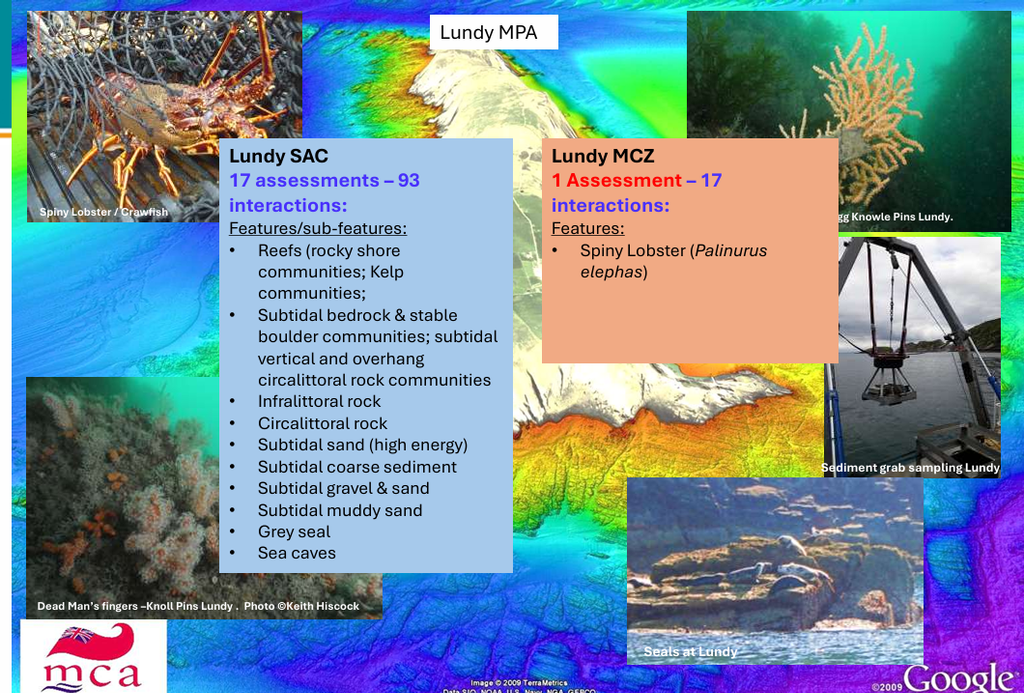
There are seven Special Areas of Conservation (SACs) within the D&S IFC’s District, designated to protect habitat type or species listed in the Annexes of the EU Habitats Directive. The number of Habitats Regulation Assessments (HRAs) undertaken for the different fishing operations and further information relating to these SACs can be viewed here. A total of 91 HRAs have been completed for these SAC between and three assessments for the Bristol Channel Approaches SAC are currently being drafted.
D&S IFCA’s District has three Special Protection Areas (SPAs) designated under the EC Birds Directive, to protect internationally and nationally important, rare, vulnerable, or regularly occurring migratory birds and their supporting habitats. Forty-seven HRAs have been completed for 224 fishing activity interactions with features and supporting habitats of D&S IFCA’s and these can be viewed here.
There are twelve Marine Conservation Zones (MCZs) designated within the D&S IFCA’s District – four on the North Coast of Devon and eight of the South Coast of the District. MCZ assessments have been undertaken since 2016 following the designation of the four Tranche1 of MCZ. The assessments for the two Tranche 2 MCZs were completed in 2018 and assessments for130 gear feature interactions for the final six Trance 3 MCZs were completed in 2022/2023. Information relating to these MCZ assessments can be viewed here. In total 78 assessments have been completed for 1693 fishing gear interactions with MCZ designated features.
In 2024/2025, the ten IFCAs were each awarded a revenue grant from Defra of £50,000 to support delivery of statutory duties relating to MPAs. This grant was intended to support the IFCAs’ resource for key MPA policy areas including implementation of fisheries management measures in all MPAs and supporting the achievement of Good Environmental Status under the Marine Strategy Regulations (2010). It also supports further assessment work and reviews, and evidence gathering.
D&S IFCA has reported to Defra the MPA work undertaken in 2025 and 2026 and these can be viewed via the links below:
- D&S IFCA MPA Work May to November 2025;
- D&S IFCA MPA Work November 2025 to March 2026;
- D&S IFCA MPA Work April 2026 to June 2026
Provision of additional Defra funding allows D&S IFCA to respond to important national workstreams, including broader consultations on fisheries and MPA management. These responses reflect D&S IFCA’s statutory remit to both protect the marine environment and support sustainable inshore fisheries.
Some examples of D&S IFCA’s MPA work include:
MPA Audit
Officers are using emerging fisheries and ecological information along with updated MPA condition assessments to inform a review of D&S IFCA’s MPA assessment work. Through this review, Officers aim to prioritise which MPA assessments require detailed updates to ensure that fishing activities and management measures are compatible with MPA Conservation Objectives. This risk-based prioritisation will inform future MPA assessment work, and is supported by a recent audit of D&S IFCA’s MPA work.
An Audit of D&S IFCA’s MPA work was presented to the Full Authority in September 2025. This presentation provided an overview of all the work D&S IFCA undertakes in relation to MPAs, research and management, and summarises information relating to the 219 assessments of fishing activities undertaken by Officers.
MMO Stage 3 MPA Consultation
In September 2025 Officers responded to the Marine Management Organisation’s (MMO) Stage 3 MPA Consultation, in which the MMO proposed management measures for a range of fishing activities in 42 MPAs in English waters, including three that co-locate with D&S IFCA’s District.
The response is available here. The response emphasised that management of fishing in MPAs must be based on robust and locally relevant ecological evidence, but where uncertainty exists, precautionary measures may be justified. The response highlighted inconsistencies between the MMO and D&S IFCA in the proposed approaches to the management of different fishing activities in MPAs. Officers were able to provide detailed evidence to the consultation which may help inform the management direction for the MMO in these sites.
Officers advocated for monitoring and iterative review of management, ensuring that measures can be adjusted as new data emerges. This is an approach taken locally by D&S IFCA through Monitoring and Control Plans, which address uncertainties in evidence to improve management approaches.
Monitoring and Control Plans (M&CPs)
M&CPs have been developed for certain fishing activities that take place within some of the MPAs in the D&S IFCA’s District. M&CPs have been introduced where uncertainties in activity and evidence gaps have been identified through MPA assessments and discussions with Natural England. Evidence gathering is undertaken to try and fill evidence gaps and provide baseline information in relation to activities and habitats. Within a M&CP, trigger points on fishing activity levels are set and further research may be undertaken on habitat location where possible. The fishing activity, within the site to which the M&CP relates, is monitored through engagement with fishers and fishing activity data such as IVMS/VMS data. Changes in activity levels and exceedance of trigger points will lead to a review of the M&CP and MPA assessments.
M&CPs currently in place in the D&S IFCA’s District are:
- Severn Estuary MPA and Plymouth Sound and Estuaries MPA – shad bycatch reporting and flyers distributed to netting permit holders o
- Hartland Point to Tintagel MCZ – trawling activity is monitored through analysis of IVMS/VMS data
- Lundy SAC – demersal towed gear (trawling and scallop dredging) activity is monitored through analysis of IVMS/VMS data
- Torbay MCZ – seasonal trawling on mud is monitored through analysis of IVMS/VMS data
- Torbay MCZ potting and netting on seagrass is monitoring through permit numbers, activity surveys and direct communication and research with fishers.
M&CP documents can be viewed here (within the Monitoring and Control Plans folder).
Co-development of Management in Torbay MCZ
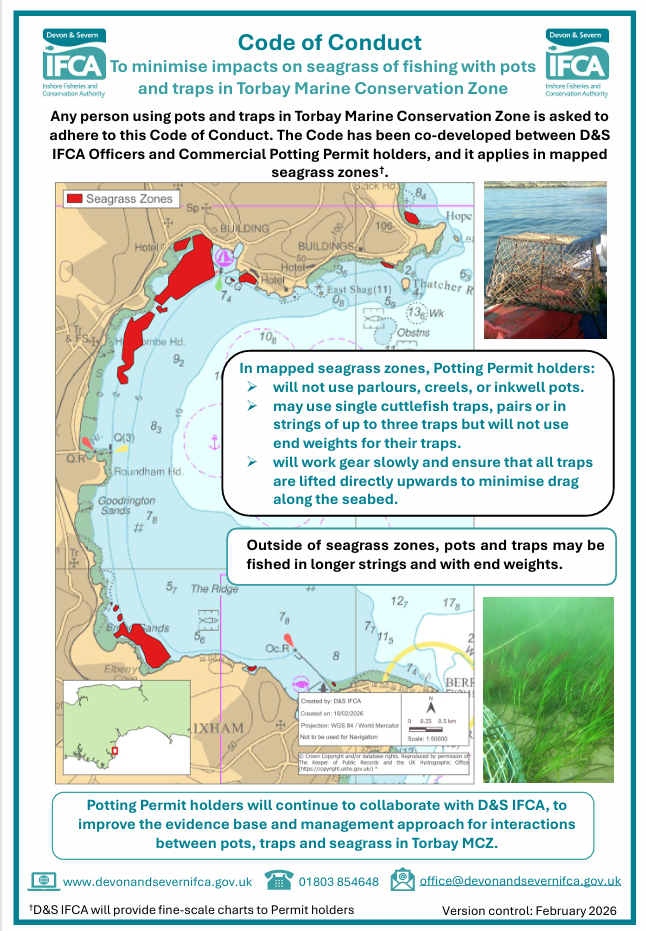
D&S IFCA Officers have undertaken MCZ assessments of the interaction of potting on the seagrass feature in the Torbay MCZ. Cuttlefish traps are known to be placed in or near the seagrass beds and the level of impacts from cuttle traps was determined, through the assessment, to be unclear. Officers undertook research in 2022 and gain in 2026 to investigate the interaction of cuttlefish traps and parlour pots with seagrass beds within the Torbay MCZ.
The work was in collaboration with local fishers, to inform co-development of a Code of Conduct for fishing with traps and pots within the MCZ. A final report on the co-development of a Code of Conduct was published in April 2026 and can be read here. The full Code of Conduct can be viewed here.
Evidence Gathering
D&S IFCA’s Environment Team undertake evidence gathering not only to inform MPA assessments but to provide evidence to inform potential management measures with in MPAs. Annual mussel stock assessments are undertaken on the Taw Torridge Estuary, which is a SSSI. These are undertaken to assess the density and distribution of mussels and the tonnage on the beds. Results are fed into a bird food availability model which assesses the level of food requirements of the important bird assemblages. The output from the model allows D&S IFCA to ensure that if commercial hand gathering of mussels takes place within the Estuary the tonnage is set at a level that ensures there is sufficient food resource for the overwintering birds that use the Estuary. The 2025 stock assessments can be viewed here.
D&S IFCA also undertaken regular molluscan surveys and crab tile surveys in several estuaries within its District designated as MPAs. The information collected from these surveys has been used to assess the need for temporary closures to mussel beds and will help inform the future development of permit byelaws relating to hand gathering in the D&S IFCA’s District.
Supporting MMO MPA Work
Officers continue to work in partnership with the Marine Management Organisation on the assessment of fishing activities in relation to the Bristol Channel Approaches MPA, designated for harbour porpoise and which straddles D&S IFCA’s District, Cornwall IFCA’s District and extends outside the 6nm boundary. Undertaking HRA assessments for this site is complex and time-consuming as mobile species provide different approaches to assessments compared to habitats. A key element of the work is understanding the potential impacts of fishing activities on harbour porpoises both within the SAC boundary and within the much larger Management Unit of the species distribution. Officers have also helped the MMO with the delivery of stakeholder workshops to discuss management options.
Local Nature Recovery Strategies
D&S IFCA submitted a detailed response to the public consultation on the Devon Local Nature Recovery Strategy (LNRS), helping to shape the future of nature conservation across the county’s land and coastal areas. The full response can be read here, which aimed to support the LNRS team in presenting accurate, evidence-based information and in identifying practical, proportionate actions that reflect both ecological priorities and the realities of inshore fisheries management.